El ocaso de la Bata Blanca: ¿otro efecto de la COVID-19?
The decline of the White Coat:another effect of COVID-19? The decline of the White Coat: another effect of COVID-19?


Cómo citar
Descargar cita

Esta obra está bajo una licencia internacional Creative Commons Atribución-NoComercial-SinDerivadas 4.0.

Mostrar biografía de los autores
Artículos más leídos del mismo autor/a
- Juan Pablo Martinez Zuluga, María Luz Sáenz Lozada, Jairo Echeverry Raad, Efectos de Adopción Y Crianza Homoparental , Archivos de Medicina (Manizales): Vol. 19 Núm. 2 (2019)







El presente documento tiene por objeto reflexionar sobre algunas circunstancias que dieron origen y perpetuaron la bata blanca como distintivo de la profesión médica, así como para prevenir del riesgo infeccioso que supone la práctica médica, hecho más manifiesto ahora por el advenimiento y globalización de la pandemia por COVID-19, que amenazan su utilización a futuro. El riesgo contaminante y de infección cruzada de la bata blanca se incrementa con el tiempo de uso.Esta cosideraciòn biológica se suma al descrédito social experimentado por la medicina en el marco de los sistemas sanitarios modernos que pretenden cobertura y eficiencia. En la transferencia de esta falta de preeminencia de la profesión a sus símbolos, la bata ha perdido para el imaginario el significado de idoneidad, pulcritud y compasión que se supone que representa. En un marco utilitarista, la bata blanca debería contribuir en la sanación por su efecto simbólico, que supera el riesgo biológico que entraña. Mientras se conciben batas blancas anticontaminantes, sea o no durante crisis sanitarias como las pandemias, los trabajadores de la salud por sus genuinas actitudes, deberían ser vistos “de blanco” ya que, parafraseando, aquellos que las portan, curan y salvan unas cuantas veces, alivian el dolor y el sufrimiento en otro tanto pero, escuchan con compasión, empatía, y acompañan y consuelan siempre (casi sin esperar nada a cambio).
Visitas del artículo 787 | Visitas PDF 361
Descargas
- Sayburn A. Covid-19: PHE upgrades PPE advice for all patient contacts with risk of infection. BMJ. 2020;
- :1-3. https://doi.org/10.1136/bmj.m1391
- John TJ, Hassan K, Weich H. Donning and doffing of personal protective equipment (PPE) for angiography
- during the COVID-19 crisis. Eur Heart J. 2020; 41(19):1786-1787. https://doi.org/10.1093/eurheartj/ehaa283
- Feinstein, JA. Short White Coat: Lessons from Patients on Becoming a Doctor. Bloomington: Universe,
- Inc.; 2009.
- Cohen JB, Lotito MJ, Trivedi UK, Denker MG, Cohen DL, Townsend RR. Cardiovascular Events and Mortality
- in White Coat Hypertension: A Systematic Review and Meta-analysis. Ann Intern Med. 2019; 170(12):853-
- https://doi.org/10.7326/M19-0223
- Pioli MR, Ritter AM, de Faria AP, Modolo R. White coat syndrome and its variations: differences and clinical
- impact. Integr Blood Press Control. 2018; 11:73-79. DOI: 10.2147/IBPC.S152761
- Suwantarat N, Supple LA, Cadnum JL, Sankar T, Donskey CJ. Quantitative assessment of interactions between
- hospitalized patients and portable medical equipment and other fomites. Am J Infect Control. 2017;
- (11):1276-1278. DOI: 10.1016/j.ajic.2017.05.003
- Bearman G, Bryant K, Leekha S, Mayer J, Munoz-Price S, Murthy R, et al. Healthcare personnel attire in nonoperating-
- room settings. Infect Control Hosp Epidemiol. 2014; 35(2):107-121. DOI: 10.1086/675066
- Munoz-Price LS, Arheart KL, Mills JP, Cleary T, DePascale D, Jimenez A, et al. Associations between bacterial
- contamination of health care workers’ hands and contamination of white coats and scrubs. Am J Infect
- Control. 2012; 40(9):e245-e248. DOI: 10.1016/j.ajic.2012.03.032
- Alhmidi H, Koganti S, Cadnum JL, Jencson AL, John A, Donskey CJ. Dissemination of a nonpathogenic viral
- DNA surrogate marker from high-touch surfaces in rooms of long-term care facility residents. Am J Infect
- Control. 2017; 45(10):1165-1167. DOI: 10.1016/j.ajic.2017.04.007
- John A, Alhmidi H, Cadnum JL, Jencson AL, Donskey CJ. Contaminated Portable Equipment Is a Potential
- Vector for Dissemination of Pathogens in the Intensive Care Unit. Infect Control Hosp Epidemiol. 2017;
- (10):1247-1249. DOI: 10.1017/ice.2017.160
- Wong D, Nye K, Hollis P. Microbial flora on doctors’ white coats. BMJ. 1991; 303(6817):1602-1604.
- DOI: 10.1136/bmj.303.6817.1602
- Klugman CM. How Health Humanities Will Save the Life of the Humanities. J Med Humanit. 2017; 38(4):419-
- DOI: 10.1007/s10912-017-9453-5
- Tsang S. Arrow physicians: are economics and medicine philosophically incompatible? J Eval Clin Pract.
- ; 21(3):419-426. DOI: 10.1111/jep.12348
- Burden M, Cervantes L, Weed D, Keniston A, Price CS, Albert RK. Newly Cleaned Physician Uniforms and
- Infrequently Washed White Coats Have Similar Rates of Bacterial Contamination After an 8-Hour Workday:
- A Randomized Controlled Trial. Journal of Hospital Medicine 2011; 6(4):177–182.
- DOI: 10.1002/jhm.864
- Harnett PR. Should doctors wear white coats? Med J Aust. 2001; 174(7):343-344.
- DOI: 10.5694/j.1326-5377.2001.tb143310.x
- Hardy S, Corones A. Dressed to heal: the changing semiotics of surgical dress. Fash Theory. 2015; 20(1):1-
- DOI: 10.1080/1362704X.2015.1077653
- Branch WT Jr. Deconstructing the white coat. Ann Intern Med. 1998; 129(9):740-742.
- DOI: 10.7326/0003-4819-129-9-199811010-00012
- Shryock RH. The Development of Modern Medicine. New York, NY: Alfred A. Knopf, Inc.; 1947:p. 248-272.
- Blumhagen DW. The doctor’s white coat. The image of the physician in modern America. Ann Intern Med.
- ; 91(1):111-116. DOI: 10.7326/0003-4819-91-1-111
- Douse J, Derrett-Smith E, Dheda K, Dilworth J. Should doctors wear white coats? Postgrad Med J. 2004;
- (943):284-286. DOI: 10.1136/pgmj.2003.017483
- Lynn LA, Bellini LM. Portable knowledge: a look inside white coat pockets. Ann Intern Med. 1999; 130(3):247-
- DOI: 10.7326/0003-4819-130-3-199902020-00039
- Blackwell B. Wearing a white coat. Gen Hosp Psychiatry. 1993; 15(2):90-91. DOI: 10.1016/0163-8343(93)90103-u
- Abagnale FW, Redding S. Catch Me If You Can: The True Story of a Real Fake. New York: B/D/W/Y. Broadway
- Books, Random House LLC NY.; 1980.
- Olvera-Lopez E, McCaffery E, Kasubhai M. White coat wearing and laundering frequency among internal
- medicine department physicians. Am J Infect Control. 2020; 48(7):834-836. DOI: 10.1016/j.ajic.2019.10.017
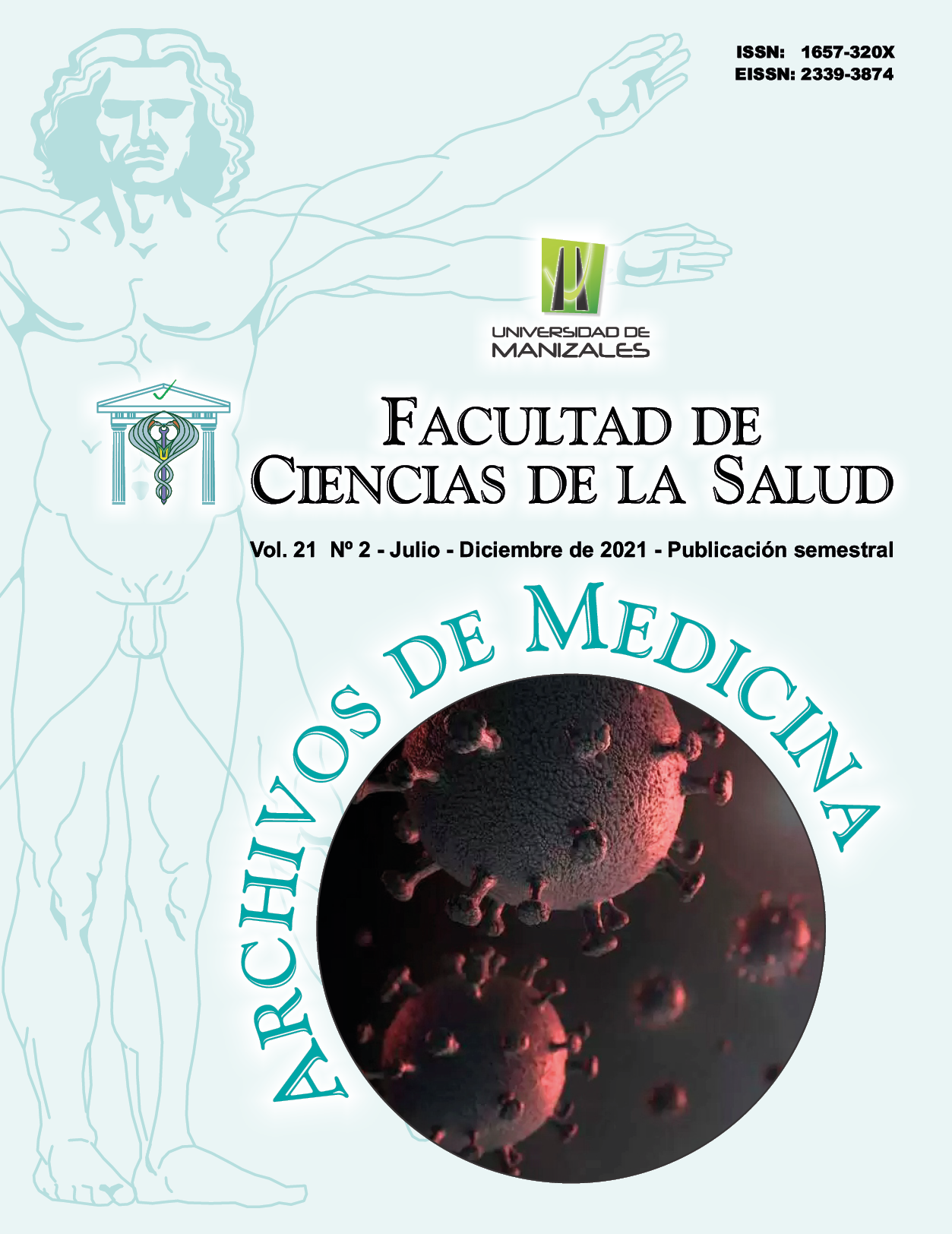
- Archivos de Medicina Volumen 21 Nº 2 - Julio-Diciembre de 2021
- Universidad de Manizales - Facultad de Ciencias de la Salud
- Kuehn BM. Time to hang up the white coat? Epidemiologists suggest ways to prevent clothing from
- spreading infection. JAMA. 2014; 311(8):786-787. DOI: 10.1001/jama.2014.794
- Bond L, Clamp PJ, Gray K, Van Dam V. Patients’ perceptions of doctors’ clothing: should we really be ‘bare
- below the elbow’? J Laryngol Otol. 2010; 124(9):963-966. DOI: 10.1017/S0022215110001167
- Bearman GM, Rosato A, Elam K, Sanogo K, Stevens MP, Sessler CN, Wenzel RP. A crossover trial of antimicrobial
- scrubs to reduce methicillin-resistant Staphylococcus aureus burden on healthcare worker
- apparel. Infect Control Hosp Epidemiol. 2012; 33(3):268-275. DOI: 10.1086/664045
- Sanders S. The stethoscope and cross-infection revisited. Br J Gen Pract. 2005; 55(510):54-55.
- Smith MA, Mathewson JJ, Ulert IA, Scerpella EG, Ericsson CD. Contaminated stethoscopes revisited. Arch
- Intern Med. 1996; 156(1):82-84.
- Vajravelu RK, Guerrero DM, Jury LA, Donskey CJ. Evaluation of stethoscopes as vectors of Clostridium
- difficile and methicillin-resistant Staphylococcus aureus. Infect Control Hosp Epidemiol. 2012; 33(1):96-98.
- DOI: 10.1086/663338
- Datz C, Jungwirth A, Dusch H, Galvan G, Weiger T. What’s on doctors’ ball point pens? Lancet. 1997;
- (9094):1824-1824. DOI: 10.1016/S0140-6736(05)63642-2
- Gudakova I, Kim J, Meredith JF, Webb G. Microbial Contamination on Touch Surfaces in Sick- and Well-
- Child Waiting Rooms in Pediatric Outpatient Facilities. Pediatr Infect Dis J. 2017; 36(12):e303-e306.
- DOI: 10.1097/INF.0000000000001759
- Pappas DE, Hendley JO, Schwartz RH. Respiratory viral RNA on toys in pediatric office waiting rooms.
- Pediatr Infect Dis J. 2010; 29(2):102-104. DOI: 10.1097/inf.0b013e3181b6e482
- Charnock C. Swabbing of waiting room magazines reveals only low levels of bacterial contamination. Br
- J Gen Pract. 2005; 55(510):37-39.
- Barrett TG, Booth I. Sartorial eloquence: does it exist in the paediatrician-patient relationship? BMJ. 1994;
- (6970):1710-1712. DOI: 10.1136/bmj.309.6970.1710
- Sebo P, Herrmann F, Haller DM. White coat in primary care: what do patients think today? Cross-sectional
- study. Swiss Med Wkly. 2014; 144:1-6. DOI: 10.4414/smw.2014.14072
- De Lott LB, Panarelli JF, Samimi D, Petrilli C, Snyder A, Kuhn L, et al. Patient Preferences for Physician Attire
- in Ophthalmology Practices. J Acad Ophthalmol. 2019; 11(1):e36-e42. DOI: 10.1055/s-0039-1688913
- Esezobor CI, Adeniyi OF, Makwe CC, Kanu OO, Bello T. What do medical interns in Nigeria think of the white
- coat? A cross sectional study. Nig Q J Hosp Med. 2013; 23(1):22-26.
- Yamada Y, Takahashi O, Ohde S, Deshpande GA, Fukui T. Patients’ preferences for doctors’ attire in Japan.
- Intern Med. 2010; 49(15):1521-1526. DOI: 10.2169/internalmedicine.49.3572
- Gooden BR, Smith MJ, Tattersall SJ, Stockler M. Hospitalised patients’ views on doctors and white coats.
- Med J Aust. 2001; 175(4):219-222.
- Zahrina AZ, Haymond P, Rosanna PC, Ho R, Rajini AR, Low BT, et al. Does the attire of a primary care physician
- affect patients’ perceptions and their levels of trust in the doctor? Malays Fam Physician. 2018; 13(3):3-11.
- Gonzalez-Del Rey JA, Paul RI. Preferences of parents for pediatric emergency physicians’ attire. Pediatr
- Emerg Care. 1995; 11(6):361-364. DOI: 10.1097/00006565-199512000-00007
- Dover S. Glasgow patients’ attitude to doctors’ dress and appearance. Health Bull (Edinb). 1991;
- (6):293-296.
- Newman AW, Wright SW, Wrenn KD, Bernard A. Should physicians have facial piercings? J Gen Intern Med.
- ; 20(3):213-218. DOI: 10.1111/j.1525-1497.2005.40172.x
- Clinicians for the Restoration of Autonomous Practice (CRAP) Writing Group. EBM: unmasking the ugly truth.
- BMJ. 2002; 325(7378):1496-1498. DOI: 10.1136/bmj.325.7378.1496
- Decamp M. Physicians, social media, and conflict of interest. J Gen Intern Med. 2012; 28(2):299-303.
- DOI: 10.1007/s11606-012-2251-x
- Rosenquist JN. The Stress of Bayesian Medicine - Uncomfortable Uncertainty in the Face of Covid-19. N
- Engl J Med. 2021; 384(1):7-9. DOI: 10.1056/NEJMp2018857
- Bentley M, Dummond N, Isaac V, Hodge H, Walters L. Doctors’ rural practice self-efficacy is associated
- with current and intended small rural locations of practice. Aust J Rural Health. 2019; 27:146-152.
- DOI: 10.1111/ajr.12486
- Verbeek JH, Rajamaki B, Ijaz S, Sauni R,Toomey E, Blackwood B, et al. Personal protective equipment
- for preventing highly infectious diseases due to exposure to contaminated body fluids in healthcare
- staff. Cochrane Database of Systematic Reviews. 2020; 4(4):1-106.
- DOI: 10.1002/14651858.CD011621.pub4
- Artículo de Reflexión sobre COVID-19
- El ocaso de la Bata Blanca en Medicina pp 611-619
- Organización Panamericana de la Salud, Organización Mundial de la Salud Guía para el cuidado crítico de
- pacientes adultos graves con coronavirus (covid-19) en las américas. Versión corta. Washington: Organización
- Panamericana de la Salud, Organización Mundial de la Salud; 2020.
- Dancer S. Pants, policies and paranoia. J Hosp Infect. 2010; 74(1):10-15. DOI: 10.1016/j.jhin.2009.10.012
- Wear D. On white coats and professional development: the formal and the hidden curricula. Ann Intern
- Med 1998; 129(9): 734-737. DOI: 10.7326/0003-4819-129-9-199811010-00010
- Haque OS, Waytz A. Dehumanization in Medicine: Causes, Solutions, and Functions. Perspect Psychol Sci.
- ; 7(2):176-186. DOI: 10.1177/1745691611429706
- La Rosa M, Spencer N, Abdelwahab M, Zambrano G, Saoud F, Jelliffe K, et al. The Effect of Wearing White
- Coats on Patients’ Appreciation of Physician Communication during Postpartum Rounds: A Randomized
- Controlled Trial. Am J Perinatol. 2019; 36(1):62-66. DOI: 10.1055/s-0038-1660470
- Petrilli CM, Mack M, Petrilli JJ, Hickner A, Saint S, Chopra V. Understanding the role of physician attire on
- patient perceptions: a systematic review of the literature-targeting attire to improve likelihood of rapport
- (TAILOR) investigators. BMJ Open. 2015; 5(1):1-18. DOI: 10.1136/bmjopen-2014-006578
- Columbia University – Inving Medical Center - Celebrates 25th Anniversary of White Coat Ceremony New
- York, NY. 2018 Accesible en :
- https://www.cuimc.columbia.edu/news/columbia-celebrates-25th-anniversary-white-coat-ceremony.
Información