Competencias ciudadanas en los lineamientos institucionales de una universidad pública de Colombia
Citizenship competencies in the institutional guidelines of a national university in Colombia


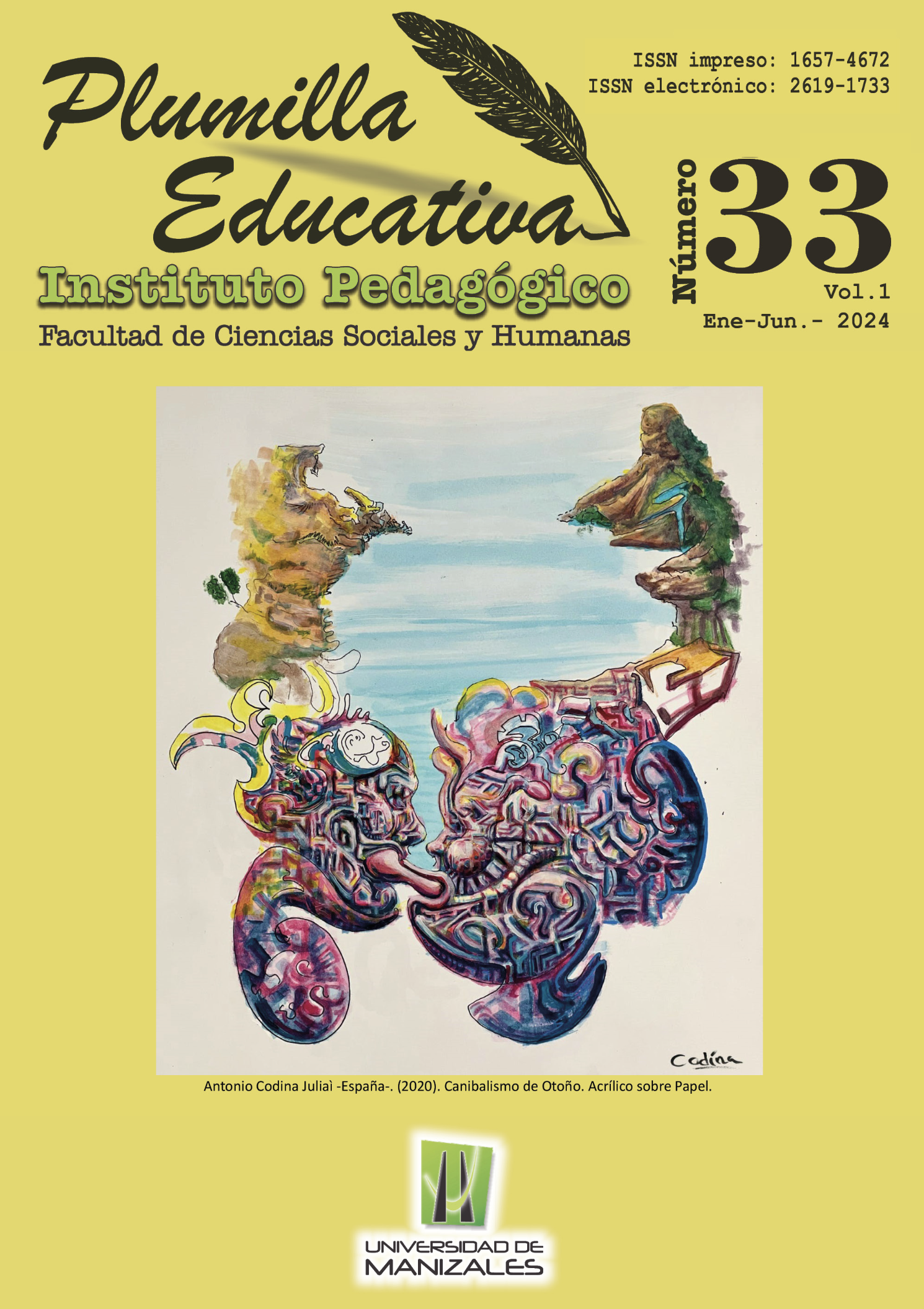
Cómo citar
Descargar cita

Esta obra está bajo una licencia internacional Creative Commons Atribución-NoComercial-CompartirIgual 4.0.

Mostrar biografía de los autores







Este estudio tuvo por objetivo analizar la implementación de las competencias y las competencias ciudadanas en los lineamientos institucionales de una universidad pública en Colombia y el conocimiento acerca de su definición y utilidad por parte de docentes y estudiantes en el año 2021. Se empleo el método cualitativo, la población fueron los lineamientos pedagógicos, los docentes y estudiantes de la facultad de educación. Para la recolección de información se empleó la revisión documental, la entrevista semiestructurada y los grupos focales. Resultados, se evidencia que los profesores y estudiantes no tienen un conocimiento claro sobre cómo se conceptualizan las competencias y competencias ciudadanas en los documentos institucionales, por lo que no hay una articulación entre la visión de la universidad y el quehacer educativo, lo que puede ocasionar que la formación de licenciados no se ajuste a las necesidades de las personas ni la sociedad.
Visitas del artículo 448 | Visitas PDF 209
Descargas
- Acosta-Medina, J. K., Torres-Barreto, M. L., Alvarez-Melgarejo, M. y Paba-Medina, M. C. (2019). Desarrollo de competencias ciudadanas en Colombia y en el mundo: contexto actual y estrategias empleadas. Universidad Industrial de Santander. Hal. https://hal.science/hal-02305098/document
- Aguilar-Forero, N., Alfaro, N., Velásquez, A. y López, V. (2020). Educacíon para la ciudadanía mundial: conectando escuelas de Colombia y Chile. Educação & Sociedade, 41(e213415), 1-16. https://doi.org/10.1590/ES.213415
- Álvarez, A. A., Sandoval, O., Saker, J. y Moreno, G. C. (2017). Competencias Ciudadanas para la Formación Integral en Educación Superior. Editorial Corporación Universidad de la Costa. https://repositorio.cuc.edu.co/bitstream/handle/11323/1169/Competencias%20ciudadanas.ACCD2E935DD7952970A5A?sequence=1
- Bernate, J., Bejarano, B. y Cardozo, D. (2020). Cotejo de las competencias ciudadanas en 2020 estudiantes de Licenciatura en Educación Física. MENDIVE, 18(3) 647-660 http://mendive.upr.edu.cu/index.php/MendiveUPR/article/view/2049
- Bicheva, I., Khizhnaya, A. & Dryakhlova, O. (2019). The role of environmental competence of the teacher in professional activities. Economic Consultant, 1(25), 69-73. https://scholar.archive.org/work/sekn4thg7fdmnasbfevvvboxxi
- Castañeda, C., Gutierrez, C., Perdomo, L., Gablán, J. y Vásquez, F. (2021). Relación entre competencias ciudadanas y acreditación de instituciones y programas académicos. Revista Guillermo de Ockham, 19(1), 111-123. http://www.scielo.org.co/scielo.php?script=sci_arttext&pid=S1794-192X2021000100111
- Cebrián, G., Junyent, M. & Mulá, I. (2020). Competencies in education for sustainable development: Emerging teaching and research developments. Sustainability, 12(2), 579. https://www.mdpi.com/2071-1050/12/2/579
- Díaz, R. E., Gallardo, K. E. y Velarde, D. (2023). Formación docente en competencias ciudadanas globales: una revisión sistemática de literatura. Sinéctica, Revista Electrónica de Educación, (60), e1469. https://doi.org/10.31391/S2007-7033(2023)0060-007
- Hernández, I., Rojas, A. F. y Luna, J. (2016). Competencias: desde la concepción de los docentes de programas de psicología. El Enfoque Basado en Competencias: Gestión, Innovación y Prospectiva (pp. 69-84). Editorial CIMTED. http://memoriascimted.com/wp-content/uploads/2017/01/el-enfoque-basado-en-competencias.pdf
- Hernández-Suárez, C. A., Avendaño-Castro, W. R. y Rojas-Guevara, J. U. (2021). Planeación curricular y ambiente de aula en ciencias naturales: de las políticas y los lineamientos a la aplicación institucional. Rev.investig.desarro.innov., 11(2), 319-334. http://www.scielo.org.co/pdf/ridi/v11n2/2389-9417-ridi-11-02-319.pdf
- Maldonado, J. (2018). Metodología de la investigación social. Paradigmas: cuantitativo, sociocrítico, cualitativo y complementario. Ediciones de la U. https://books.google.com.co/books/about/Metodolog%C3%ADa_de_la_investigaci%C3%B3n_social.html?id=FTSjDwAAQBAJ&redir_esc=y
- Ministerio de Educación Nacional. (2011). Orientaciones para la institucionalización de las competencias ciudadanas. Amado impresores. https://siteal.iiep.unesco.org/sites/default/files/sit_accion_files/11156.pdf
- Monterrosa, N. (2020). Competencias ciudadanas: Ejes presentes en el sector estudiantil colombiano. TeloS, 22(2), 375-384. https://www.redalyc.org/journal/993/99364322009/html/
- Morin, E. (1999). Los siete saberes necesarios para la educación del futuro. UNESCO. https://unesdoc.unesco.org/ark:/48223/pf0000117740_spa
- Noble, H. & Heale, R. (2019). Triangulation in research, with examples. Evidence-based nursing, 22(3), 67-68. https://ebn.bmj.com/content/22/3/67
- Padilla, L. A. (2011). Competencias ciudadanas en los estudiantes universitarios. Revista de investigaciones UNAD, 10(1), 197-217. https://academia.unad.edu.co/images/investigacion/hemeroteca/revistainvestigaciones/volumen10num1%202011/14.%20Competencias%20ciudadanas%20en%20los.pdf
- Pang, E., Wong, M., Leung, C. & Coombes, J. (2018). Competencies for fresh graduates success at work: Perspectives of employers. Industry and higher education, 33(1), 55-65. https://journals.sagepub.com/doi/pdf/10.1177/0950422218792333#:~:text=’Ability%20and%20willingness%20to%20learn,are%20clearly%20necessary%20for%20success.
- Pérez, J., Nieto, A. & Santamaría, J. (2020). Hermeneutics and Phenomenology in Human and Social Sciences Research. Civilizar: Ciencias sociales y humanas, 20(38), 137-146. https://revistas.usergioarboleda.edu.co/index.php/ccsh/article/view/v20n38a10
- Putman, S. & Byker, E. (2020). Global citizenship 1-2-3: Learn, think, and act. Kappa Delta Pi Record, 56(1), 16-21. https://www.tandfonline.com/doi/abs/10.1080/00228958.2020.1696088?journalCode=ukdr20
- Rojas, A. F. y Hernández, I. (2018). Competencias docentes en los lineamientos institucionales y de programa. I+D Revista de Investigaciones, 12(2), 27-38. DOI: https://doi.org/10.33304/revinv.v12n2-2018003
- Rojas, A. F., Luna, J. A. y Hernández, I. (2019). Competencias docentes transversales para el quehacer de profesores de pregrado en Psicología. Educación Y Educadores, 21(3), 461–481. https://doi.org/10.5294/edu.2018.21.3.5
- Semerikov, S., Striuk, L., Striuk, M. & Shalatska, H. (2020). Sustainability in Software Engineering Education: a case of general professional competencies. E3S web of conferences, 166, 1-13. https://www.e3s-conferences.org/articles/e3sconf/pdf/2020/26/e3sconf_icsf2020_10036.pdf
- Tobón, S. (2005). Formación basada en competencias. Pensamiento complejo, diseño curricular y didáctica. ECOE Ediciones. https://bibliotecadigital.uchile.cl/discovery/fulldisplay/alma991004905189703936/56UDC_INST:56UDC_INST
- Weinberg, M. (2018). Learning for democracy: The politics and practice of citizenship education. British educational research journal, 44(4), 573-592. https://bera-journals.onlinelibrary.wiley.com/doi/full/10.1002/berj.3446
Información



















Palabras clave
ISSN impreso: 1657-4672
ISSN electrónico: 2619-1733