O sentido da vida e a missão educativa: para uma pedagogia da plenitude humana


Como Citar
Baixar Citação

Este trabalho está licenciado sob uma licença Creative Commons Attribution-NonCommercial-NoDerivatives 4.0 International License.


##submission.authorBio##






Este artigo explora a relação entre o sentido da vida e a educação, sublinhando a necessidade de uma pedagogia que transcenda a mera transmissão de conhecimentos para se orientar para a plenitude humana. Partese da constatação de que a crise cultural conteporânea, marcada pela fragmentação e pela perda de horizontes partilhados, exige uma reflexão pedagógica profunda sobre os fins da educação. Através da análise hermenêutica das principais contribuições de diversos autores, defendese que educar é acompanhar as pessoas na busca de significados que integrem razão, afetividade e compromisso ético. O texto sustenta que a educação deve assumir explicitamente a sua dimensão existencial, promovendo espaços de diálogo, autoconhecimento e abertura à pluralidade de cosmovisões. Concluise que a pedagogia do sentido constitui hoje uma exigência ineludível para garantir a formação integral das novas gerações.
Visão geral 460 | Visualizações de PDF 232
Downloads
- Antonovsky, A. (1987). Unraveling the mystery of health: How people manage stress and stay well. Jossey-Bass.
- Bauman, Z. (2007). Liquid times: Living in an age of uncertainty. Polity Press.
- Bermejo Fernández-Nieto, J. (2024). Sentido de la vida y propósito personal ¿Nuevo reto para las organizaciones? Lúmina, 25(1), E0052. https://doi.org/10.30554/lumina.v25.n1.4925.2024
- Baumeister, R. F., Vohs, K. D., Aaker, J. L., & Garbinsky, E. N. (2013). Some key differences between a happy life and a meaningful life. The Journal of Positive Psychology, 8(6), 505–516. https://doi.org/10.1080/17439760.2013.830764
- Chukwuorji, J. C., Agbo, A. A., Ajaero, C. K., & Ifeagwazi, C. M. (2024). Presence of meaning in life and subjective well-being as mediators of association between sense of community and academic engagement. Revista Colombiana de Psicología, 32(2), 85-101. https://doi.org/10.15446/rcp.v33n2.99606
- Damon, W. (2008). The path to purpose: Helping our children find their calling in life. Free Press. De Ruyter, D. J., & Schinkel, A. (2022). Education and meaning in life. In I. Landau (Ed.), The
- Oxford Handbook of Meaning in Life (pp. 492–C31.P90). Oxford University Press. https://doi.org/10.1093/oxfordhb/9780190063504.013.32
- Eagleton, T. (2007). The meaning of life: A very short introduction. Oxford University Press. Frankl, V. E. (2004). El hombre en busca de sentido. Herder.
- Gadamer, H.-G. (1999). Truth and method (2nd ed.). Continuum.
- Grondin, J. (2004). Del sentido de la vida. Un ensayo filosófico. Barcelona, Herder. Jaeger, W. (1989). Paideia: Los ideales de la cultura griega. Fondo de Cultura Económica. Kristjánsson, K. (2018). Virtuous emotions. Oxford University Press. https://doi.org/10.1093/oso/9780198809678.001.0001
- Landau, I. (2017). Finding meaning in an imperfect world. Oxford University Press. https://doi.org/10.1093/acprof:oso/9780190657666.001.0001
- Lipman, M. (2003). Thinking in education (2nd ed.). Cambridge University Press.
- Martela, F., & Steger, M. F. (2016). The three meanings of meaning in life: Distinguishing coherence, purpose, and significance. The Journal of Positive Psychology, 11(5), 531–545. https://doi.org/10.1080/17439760.2015.1137623
- Metz, T. (2013). Meaning in life: An analytic study. Oxford University Press. https://doi.org/10.1093/acprof:oso/9780199599318.001.0001
- Moore, T. (1992). Care of the soul: A guide for cultivating depth and sacredness in everyday life. HarperCollins.
- Noddings, N. (2013). Education and democracy in the 21st century. Teachers College Press. Nussbaum, M. C. (2010). Not for profit: Why democracy needs the humanities. Princeton University Press. https://doi.org/10.1515/9781400883509
- Pannenberg, W. (1990). Anthropology in theological perspective. T&T Clark.
- Rahner, K. (1995). Foundations of Christian faith: An introduction to the idea of Christianity. Cros- sroad.
- Schinkel, A., Reuyter, D. J. y Aviram, A. (2016). Education and Life´s Meaning. Journal of Philo- sophy of Education, 50(3), 398-418. https://doi.org/10.1111/1467-9752.12146
- Schinkel, A. (2022). Wonder, education, and human flourishing. VU University Press. Seachris, J. W. (2013). Exploring the meaning of life: An anthology and guide. Wiley-Blackwell.
- Steger, M. F., Frazier, P., Oishi, S., & Kaler, M. (2006). The meaning in life questionnaire: Assessing the presence of and search for meaning in life. Journal of Counseling Psychology, 53(1), 80–93. https://doi.org/10.1037/0022-0167.53.1.80
- Taylor, C. (2007). A secular age. Harvard University Press. https://doi.org/10.4159/9780674044289 UNESCO (2023). Ready to learn and thrive: School health and nutrition around the world. United Nations Educational, Scientific and Cultural Organization. https://doi.org/10.54675/DSHQ1076
- Van Manen, M. (1990). Researching lived experience: Human science for an action sensitive pedagogy. State University of New York Press.
- White, J. (2009). Education and a meaningful life. Oxford Review of Education, 35(4), 423–435. https://doi.org/10.1080/03054980902830134
- Williams, B. (2006). Philosophy as a humanistic discipline. Princeton University Press.
- Wong, P. T. P. (Ed.) (2012). The human quest for meaning: Theories, research, and applications. Routledge.
- World Health Organization. (2022). World mental health report: Transforming mental health for all.
- World Health Organization
- Yalom, I. D. (1980). Existential psychotherapy. Basic Books. Zizek, S. (2008). Violence. Picador.
- ZiZek, S. (2014). Event: A philosophical journey through a concept. Penguin.
Informações
















Palavras-chave
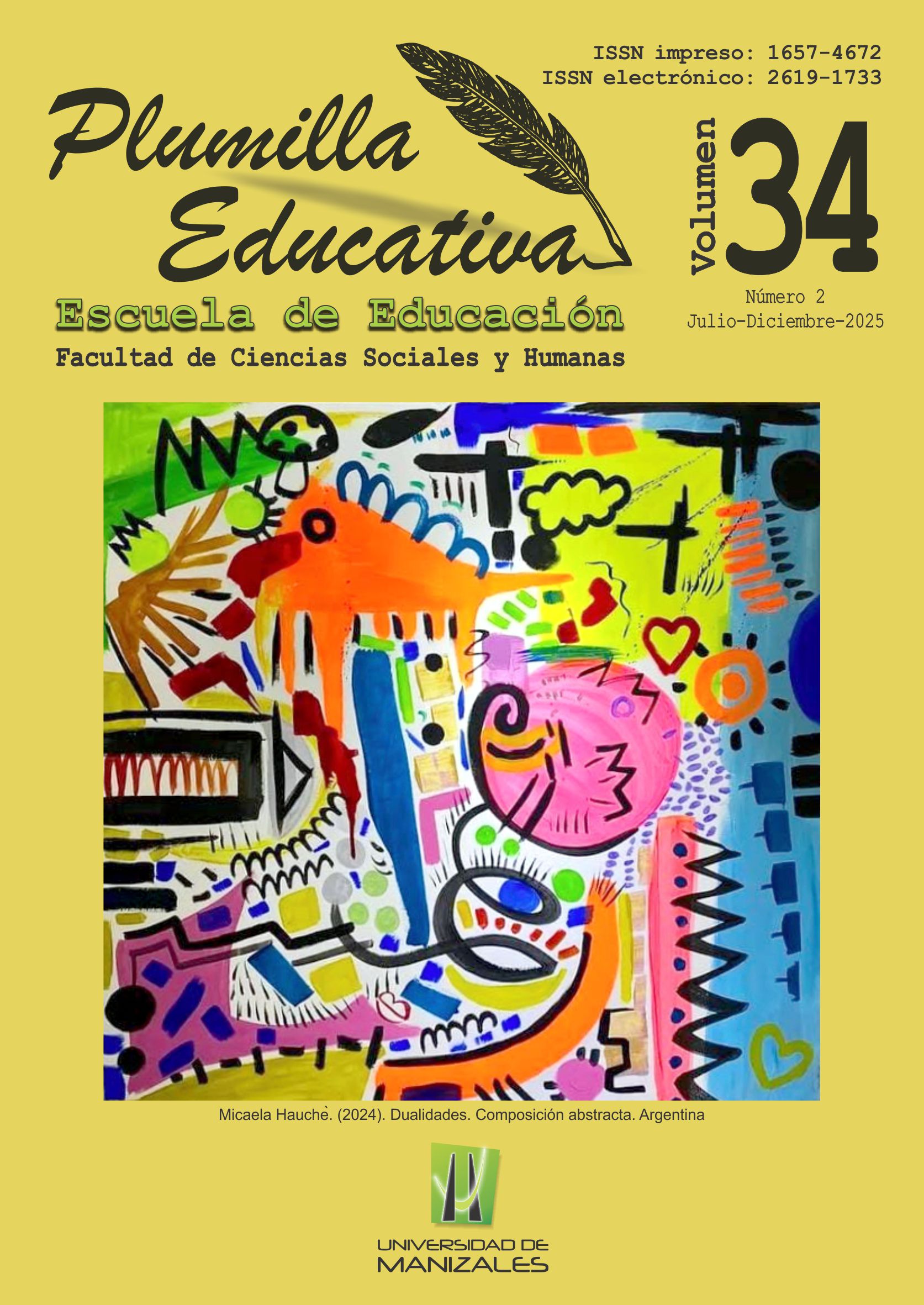
ISSN impreso: 1657-4672
ISSN electrónico: 2619-1733