Conventional biomarkers for cardiovascular risks and their correlation with the castelli risk index-indices and tg/hdl-c
Conventional biomarkers for cardiovascular risks and their correlation with the castelli risk index-indices and tg/hdl-c


How to Cite
Download Citation

Show authors biography







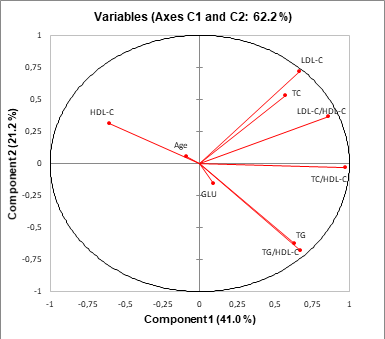
Objective: to evaluate the correlation between a group of conventional biomarkers of cardiovascular risk with the Castelli-I and Castelli-II indices, and TG/HDL-C ratio in patients assigned to a program of cardiovascular risk for users of the clinical laboratory service of an institution that provides health services in the southwest of the Colombia. Materials and Methods: retrospective, descriptive multivariate exploratory study, carried out in 2 126 patients. Some sociodemographic variables were analyzed, as well as glucose and lipid profile. The Castelli-I and Castelli-II indices, and TG/HDL-C ratio were calculated. The correlation among the variables was evaluated through a matrix of correlations, the correlation index and the Bartlett’s Test of Sphericity. The analysis ended with a study of main components, which allowed to identify how the variables studied were grouped into components that characterized the population. Results: the average age was 56 ± 11 years; 68.7% were women; 48% hypercholesterolemic and 49% hypertriglyceridemic; 22% with alterations in glucose. Total cholesterol correlated positively with LDL-C and triglycerides negatively with HDL-C. Two components characterized the population, one related to cardiovascular risk and the other to lipid alterations. Conclusions: conventional biomarkers reveal high prevalences in dyslipidemias, in contrast to atherogenic indices. The results highlight the importance of considering the evaluation of these indices in primary care and the need to strengthen the measurement systems of clinical laboratories for the reliability of the data on which decisions are made for the management of these patients.
Article visits | PDF visits
Downloads
- Ama VJ, Ndongo S, Ombotto S, Ntone F, Wouamba DE, Ngo B. Dyslipidemia in Patients with a Cardiovascular Risk and Disease at the University Teaching Hospital of Yaoundé, Cameroon. International Journal of Vascular Medicine 2017; 2017:6061306. DOI: https://doi.org/10.1155/2017/6061306
- Arca M, Montali A, Valiante S, Campagna F, Pigna G, Paoletti V, et al. Usefulness of Atherogenic Dyslipidemia for Predicting Cardiovascular Risk in Patients With Angiographically Defined Coronary Artery Disease. Am J Cardiol 2007; 100(10):1511–1516. DOI: 10.1016 / j.amjcard.2007.06.049
- Gawryszewski V, Souza MF. Mortality due to cardiovascular diseases in the Americas by region, 2000-2009. Sao Paulo Med J 2014; 132(2):105-110. DOI: 10.1590/1516-3180.2014.1322604
- Goliasch G, Wiesbauer F, Blessberger H, Demyanets S, Wojta J, Huber K, et al. Premature myocardial infarction is strongly associated with increased levels of remnant cholesterol. J Clin Lipidol 2015; 9:801–6. DOI: https://doi.org/10.1016/j.jacl.2015.08.009
- Millán J, Pintó X, Muñoz A, Zúñiga M, Rubiés-Prat J, Pallardo LF, et al. Lipoprotein ratios: Physiological significance and clinical usefulness in cardiovascular prevention. Vasc Health Risk Manag 2009; 5:757–765.
- Criqui MH, Golomb BA. Epidemiologic aspects of lipid abnormalities. Am J Med 1998; 105:48S–57S. DOI:10.1016 / s0002-9343 (98) 00212-5
- Akpinar O, Bozkurt A, Acartürk E, Seydaoglu G. A new index (CHOLINDEX) in detecting coronary artery disease risk. Anadolu Kardiyol Derg 2013; 13:315–9. DOI: 10.5152 / akd.2013.098
- Edwards M, Blaha M, Loprinzi P. Atherogenic Index of Plasma and Triglyceride/High-Density Lipoprotein Cholesterol Ratio Predict Mortality Risk Better Than Individual Cholesterol Risk Factors, Among an Older Adult Population. Mayo Clin Proc 2017; 92(4):680-686. DOI: 10.1016/j.mayocp.2016.12.018
- Gaojun C, Ganwei S, Sheliang X, Wei L. The atherogenic index of plasma is a strong and independent predictor for coronary artery disease in the Chinese Han population. Medicine 2017; 96:37. DOI: 10.1097/MD.0000000000008058
- Olamoyegun MA, Oluyombo R, Asaolu SO. Evaluation of dyslipidemia, lipid ratios, and atherogenic index as cardiovascular risk factors among semi-urban dwellers in Nigeria. Ann Afr Med 2016; 15(4):194-199. DOI: 10.4103/1596-3519.194280
- Ray A, Talukdar NS, Saha M, Kundu S, Khanra D, Guha S, et al. Serum lipoprotein ratios as markers of insulin resistance: A study among non-diabetic acute coronary syndrome patients with impaired fasting glucose. Indian J Med Res 2015; 141(1): 62–67. DOI: 10.4103 / 0971-5916.154504
- Kim JS, Kim W, Woo JS, Lee TW, Ihm CG, Kim YG, et al. The Predictive Role of Serum Triglyceride to High-Density Lipoprotein Cholesterol Ratio According to Renal Function in Patients with Acute Myocardial Infarction. PLoS ONE 2016; 11(10): 1-16. DOI: 10.1371/journal.pone.0165484
- Schofield JD, Liu Y, Rao-Balakrishna P, Malik RA, Soran H. Diabetes Dyslipidemia. Diabetes Ther 2016; 7(2):203–219. DOI: 10.1007/s13300-016-0167-x
- Kovach Computing Services XLSTAT. 2018. [software] [On-line] Available:
- URL: http://www.kovcomp.co.uk/XLStat/downl.html
- Peña D. Análisis de Datos Multivariantes. Madrid: Mc Graw-Hill; 2002.
- Machado J, Machado M. Prevalencia de factores de riesgo cardiovascular en pacientes con dislipidemia afiliados al sistema de salud en Colombia. Rev Peru Med Exp Salud Pública 2013; 30(2):205-11.
- Galvis Pérez Y, Barona Acevedo J, Cardona-Arias JA. Prevalencia de dislipidemias en una institución prestadora de servicios de salud de Medellín (Colombia). 2013. Rev CES Med 2016; 30(1):3-13.
- Muñoz O, García A, Fernández D, Higuera A, Ruiz A, Aschner P, et al. Guía de práctica clínica para la prevención, detección temprana, diagnóstico, tratamiento y seguimiento de las dislipidemias en la población mayor de 18 años. Act Méd Colomb 2014; 39(2-2S):5-27.
- Velásquez CM, Orozco JM. Dislipidemia en niños con desnutrición aguda. Turbo, Colombia. Perspect Nutr Humana 2012; 14:157-170.
- Alayón A, Alverar C. Prevalencia de Desórdenes del metabolismo de los Glúcidos y Perfil del Diabético en Cartagena de Indias (Colombia), 2005. Salud Uninorte. 2011; 22(1):20-8.
- Schiebinger L, Klinge I, Sánchez de Madariaga I, Paik H, Schraudner M, Stefanick M. Gendered innovations in science, health, medicine, engineering and environment. Palo Alto: Stanford University;. 2015.
- Regitz-Zagrosek V, Oertelt-Prigione S, Prescott E, Franconi F, Gerdts E, Foryst-Ludwig A, et al. Gender in cardiovascular diseases: impact on clinical manifestations, management, and outcomes. Eur Heart J 2016; 37:24–34. DOI: 10.1093 / eurheartj / ehv598
- Kautzky-Willer A, Harreiter J, Pacini G. Sex and Gender Differences in Risk, Pathophysiology and Complications of Type 2 Diabetes Mellitus. Endocrine Reviews 2016; 37(3):278–316. DOI: 10.1210 / er.2015-1137
- Anyigor-Ogah CS, Onwe PE, Obimma J, Ottah-Umahi G, Okorocha AE. Menopause and serum Lipid Profile a Review. Quest Journals Journal of Medical and Dental Science Research 2015; 2(11):16-25.
- Instituto Nacional de Salud, Observatorio Nacional de Salud. Segundo Informe ONS: Mortalidad 1998-2011 y situación de salud en los municipios de frontera terrestre en Colombia. Bogotá DC: Imprenta Nacional de Colombia; 2013.
- Willey J Z, Rodriguez CJ, Carlino RF, Moon YP, Paik MC, Boden-Albala B, Elkind MS. Race-ethnic differences in the relationship between lipid profile components and risk of myocardial infarction: the Northern Manhattan Study. Am Heart J 2011; 161(5):886–892. DOI: 10.1016 / j.ahj.2011.01.018
- Graham G. Racial and Ethnic Differences in Acute Coronary Syndrome and Myocardial Infarction Within the United States: From Demographics to Outcomes. Clin. Cardiol 2016; 39(5):299–306. DOI: 10.1002 / clc.22524
- Oh YS. Mechanistic insights into pancreatic beta-cell mass regulation by glucose and free fatty acids. Anat Cell Biol 2015; 48(1): 16-24. DOI: 10.5115 / acb.2015.48.1.16
- de Ferranti SD , de Boer IH , Fonseca V , Fox CS , Golden SH , Lavie CJ , et al. Type 1 diabetes mellitus and cardiovascular disease: a scientific statement from the American Heart Association and American Diabetes Association. Circulation. 2014; 130(13): 1110-30. DOI: 10.1161 / CIR.0000000000000034
- Graham I, Shear CH, De Graeff P, Boulton C, Catapano A, Gattis W, et al. New strategies for the development of lipid-lowering therapies to reduce cardiovascular risk. Eur Heart J 2018; 4: 19–127. DOI: 10.1093/ehjcvp/pvx031
- Ponte-Negretti CI, Isea-Pérez J, Lanas F, Medina J, Gómez-Mancebo J, Morales E, Lanas F, et al. Atherogenic dyslipidemia in Latin America: prevalence, causes and treatment. Consensus. Rev Mex Cardiol 2017; 28(2):54-85.
- Gavrielides MA, Zeng R, Myers KJ, Sahiner B, Petrick N. Benefit of overlapping reconstruction for improving the quantitative assessment of CT lung nodule volume. Acad Radiol 2013; 20(2):173-80. DOI: 10.1016 / j.acra.2012.08.014
- Hernández-Vite Y, Elizalde-Barrera CI, Flores-Alcántar MG, Vargas-Ayala G, Loreto-Bernal ML. Asociación entre el índice triglicéridos/colesterol HDL y la glucosa alterada en ayuno en pacientes normotensos con obesidad y sobrepeso. Med Int Méx 2015; 31:507-515.
- Morejón O, Triana ME. Importancia de la interpretación del colesterol total y de los triglicéridos para el diagnóstico de las dislipidemias. Rev Cubana Angiol Cir Vasc 2015; 16(1):54-63.
- Bermúdez A, Robayo D. Vigilancia por laboratorio de las enfermedades crónicas: una estrategia para las enfermedades metabólicas. NOVA 2016; 13(26):89-97.
- Orth M, Averina M, Chatzipanagiotou S, Faure G, Haushofer A, Kusec V, et al. Opinion: redefining the role of the physician in laboratory medicine in the context of emerging technologies, personalised medicine and patient autonomy (‘4P medicine’). J Clin Pathol 2019; 72 (3):191-197. DOI: 10.1136 / jclinpath-2017-204734
- Cnop M, Welsh N, Jonas JC, Jorns A, Lenzen S, Eizirik DL. Mechanisms of pancreatic beta-cell death in type 1 and type 2 diabetes: many differences, few similarities. Diabetes 2005; 54 Suppl 2: S97–S107. DOI: 10.2337 / diabetes.54.suppl_2.s97
- Drew BG, Rye KA, Duffy SJ, Barter P, Kingwell BA. The emerging role of HDL in glucose metabolism. Nat Rev Endocrinol 2012; 8:237–245. DOI: 10.1038 / nrendo.2011.235
- Frank AT, Zhao B, Jose PO, Azar KM, Fortmann SP, Palaniappan LP. “Racial/Ethnic Differences in Dyslipidemia Patterns”. Circulation 2014; 129(5):570–579. DOI: 10.1161 / CIRCULACIÓN AHA.113.005757
Information