
Plumilla Educativa
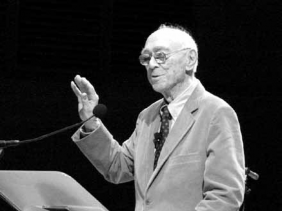
Jerome Seymour Bruner, born in New York in 1915. Is a psychologist and educator. He served in department of Cognitive Psychology at the Uni- versity of Harvard and, with G. Miller founded the Center for Cognitive Studies, considered the first center of cognitive psychology. Jerome Bruner was director of the center, located in the same Harvard University, where
B. F. Skinner taught his theory of operant learning. He later moved to England where dictate classes at the University of Oxford. Bruner distin- guishes three basic modes by which man represent the reality. These are
the ways acting (inactive), iconic and symbolic.
Some of the books published by Bruner.
The process of education.
A Study of Thinking.
Studies in Cognitive growth.
Toward a Theory of Instruction.
Going Beyond the Information Given.
Child’s Talk: Learning to Use Language.
The importance of education.
Actual Minds, Possible Worlds.
Acts of meaning.
Education, Culture door.
Currently (2010) Bruner continues giving his knowledge at several universities, but mainly in New York. He has received numerous awards from institutions around the world.
In the deepest sense, psychology seeks to understand the human condition. But the human condition, give its multiple nature, is not easily understood. Or perhaps it would be better to say that it can be understood in many ways, ways that may seem incom- patible with each other. For in some deep sense, the human condition is shaped both by the biological constraints inherent in our nature as a species living in a particular physical environment, but at the same time it is also shaped by the symbolically rich cultures that we humans construct and in terms of which we live our lives communally.
Indeed, we uniquely as a species are both limited biologically in our human con- dition, but at the same time liberated from that condition by our striking capacity to go beyond it by our capacity to go beyond it by our capacity to imagine and create “possi- ble worlds” that transcend that condition. In a word, then, we are both constrained by our biology and liberated from it by the cultures we create to actualize those possible worlds. There is no species on the face of earth so marked by such a duality. Our human lives, as it were, are a never ending dialectic between inherited constraints and the possibilities generated and realized by cultural means.
And besides, as we well know, our reali- zation of the possible, far-reaching though it may be, is also limited by that we might call the intrinsic constraints of culture. For in their very nature, cultures are also constraining on those who live within their bounds. In their very nature, cultures too
limit the freedom of those who live under their sway. Cultures too are constraining in their ways, for they are institutionalized to maintain stability and order, whether by custom or by legal systems designed to punish impermissible departures from the customary.
Even when we ignore biological cons- traints, the human condition, viewed cul- turally, is an endless dialectic between the already Established and what we imagine to be possible, between convention and temptations, as it were. Yet, it is in our very nature to shape a way of life for ourselves that makes it feasible to do so –though, alas, we sometimes pay a high price in uncertainty and anxiety for it.
It is this often conflicted form of life, this perpetual compromise between the already Established and the imaginatively possible, that both generates our human troubles and, at the same time, provokes human creativity. Living life in full confor- mity to the Established creates boredom and banality. Living with a view only to the possible is a pretty sure way of ending up in prison! Indeed, the challenge of life is to find a viable compromise between the Established and the possible.
And it is this challenge that I want to address. Indeed, it is this challenge that shapes how psychology goes about or should go about its business in resear- ching the nature of man and his condition. Yet, let me confess that I did not reach this conclusion only speculatively. I was virtua- lly forced into it by trying to make sense of

* Fortunately, we could contact the master Jerome Bruner, who after several statements and clarifications on the interest of the academic community on their studies and research, he has been accepted publish this paper in the Journal Plumilla Educatifa of the University of Manizales, Colombia, entitled -What should psychology study, and why? Professor Bruner asked to be published in both languages English and Spanish to solve the needs of the readers to know the original text against changes that may arise to be turned into Spanish. In this sense, the Spanish translation was done by Miguel Alberto González González, director of the Plumilla Educativa social science journal.
my own research findings. So let me begin by telling you briefly how this came about.
Indeed, it started with my early effort to clarify what constitutes perception, how we make sense of what impinges on our sen- ses. How lengthy an input of a stimulus, for example, is needed for it to be correctly recognized? My research instrument was a tachistoscope, a gadget that varies the length of exposure of a display. I’d begin by showing each subject a thousandth or so of a second of input of a picture or design of some sort, then increasing the exposure time to see how lengthy an exposure it would take for a subject to correctly recog- nize the display. Simple enough.
What I very soon discovered was my subjects, no matter what the stimulus and no matter how brief the exposure, were never passively waiting for a long enough exposure to see what was being displayed in my fancy tachistoscope. Rather, they were brimming with answers no matter how brief the exposure, literally construc- ting their percepts no matter how brief the input exposure might have been. And they did so in a strikingly conventional, even banal way. Unconventional inputs were typically conventionalized.
But interestingly, as exposure times were lengthened on successive trials, my subjects would characteristically get stuck with the percepts they’d construc- ted on earlier, briefer exposure. Their perceptions, in a word, were attempted interpretations of what was being exposed
hypotheses about the “world” in which they found themselves. Eventually, with a long enough time exposure, they’d see the picture or design or word correctly (but often with a gasp of surprise, having been earlier well convinced that they’d “seen” it correctly on a briefer exposure).
In a word, they not just passively “recei- ving” the presented input, but constructing it and doing so along quite conventional lines. They were attempting to “make sense” as best they could – and getting stuck in their conventionalized constructions. It would
sometimes take twice as long for them to recognize a display correctly as it would take a subject who had not been through those very brief exposures. Plainly, they were victims of their own efforts.
All of which led me to formulate what I called a hypothesis theory of perception: that perceiving was guided by, steered by hypotheses about what was to be conventionally expected. So, for example, eight-letter pseudo-words that were distant approximations to English took a much longer exposure time to be recognized than ones that more closely approximated conventional English letter sequences. Words (and pseudo-words) are processed with the expectation that they conform to spelling conventions or to social convention generally. And so, for example, dirty words (and lewd pictures) take much longer to re- cognize than conventionally “proper” ones if you start sequence of exposures way down below threshold level. Subjects get stuck with their wrong, early hypotheses.
But note one other thing. Once a subject has been tachistiscopically exposed to a lewd picture or dirty word, he’ll more easily recognize such pictures or words when subsequently presented to him. I asked one of our undergraduate subjects why he thought this was so. “Good lord,” he said, “You don’t expect to be shown dirty pictures in a Harvard lab, do you? But then things change” and that remark from that seventeen-years-old freshman, led me to another line of work – and to a refinement of the hypothesis theory.
It had to do with the nature of expectancy. Let me put it this way. Your expectations are both situationally determined (you don’t expect to be shown dirty pictures in a tachistoscape in a respectable Harvard laboratory), but also more generally deter- mined both by your own personal charac- teristics and by the social customs of your own culture or sub-culture, even grating that the two often interact in what the French like to call your deformation professionelle. I sometimes look at the world passing by as
a seasoned old New Yorker, sometimes as a psychologist law professor, sometimes as an adventurer. And how I do so will depend on whom I’m with, on what I’m doing, and other circumstantial matters.
How can a psychologist ignore such ob- vious matters in studying human behavior? And do our conventional psychological methods of research – the laboratory, the conventional interview, standardized test, and the rest – take them into account? A psychologist can learn a lesson or two from the anthropologist, the sociologist, even the historian. We will never understand human behavior simply by studying it in vitro or out of context, (only in the here- and-now), without taking account of the historical compromise that always exists between the Established and the possible.
Why, for example, is the United States the only country left in the western world hat still punishes capital crimes with the death penalty? Public opinion polls indi- cate that Americans are no more in favor of such a practice than any other country. How come, then, that we go on using this barbaric and demonstrably ineffective practice – ineffective, for it is known that states that still use the death penalty do not thereby reduce their capital crime rate. My colleague David Garland has just published a stunning book on this baleful topic (peculiar institution, Cambridge: Harvard university press, 2010) and it is plain that the persistence of this barbaric practice depends upon a false appeal to people’s “concern about public welfare” (p. 63). Capital punishment is presented as part of a war against the crime. We kill people in wars, don’t we? Here is a verbatim citation of a prosecutor’s typical argument before the jury in a murder trial, cited by Garland (p. 63): “I say to you we’re in a war again in this country, except it’s not a foreign nation, it’s against the criminal element in this country. The defendant, William Brooks, is a member of the criminal element, and he’s our enemy.” So, the administration of justice is converted into a “war on crime,” and,
as in a war, your duty is to destroy the enemy. Not to do so is unpatriotic.
Garland, the author of that book, is a Scotsman, a lawyer and sociologist, all of which help him be a shrewd psychological observer of the American scene. But he also senses the importance of story-telling. As he rightly notes, it is the genre of na- rrative that was central to the prosecuting attorney’s appeal to the jury. A murder, like an enemy combatant, deserves nothing better than death. Not simply retribution, but deadly warfare: put your enemy to death.
So to return now to what psychology should include, or more generally, on what psychology should be modeled. I would definitely include the part-literary, part-anthropological, part-historical study of everyday ways of classifying the events we must live which. Indeed, this is a lesson that is being learned in virtually all discipli- nes concerned with the human condition
even in that most rigid discipline of law and jurisprudence.
Let me turn now to a related matter already hinted at. It has to do with how a culture’s ways become internalized, incorporated in our individual ways of conceiving of the world, how we become “members” of a culture and come to inter- nalize its ways as features of our Selves
“self-formation,” or however you wish to characterize it. It is the domain of what we usually call Developmental Psychology, a field that has made enormous progress over the last quarter century thanks princi- pally to a dialetic between two approaches. Let me call one of them the Piagetian approach, and the other the Vygotskian.
Piaget was concerned principally with structure, how our knowledge of the world is put together in an orderly fashion, first in a particularized and highly concrete way and then increasingly organized into trans- formably abstract structures open to a wide range of construals and reconstruals. How, in a word, do we organize our encounters with the world in a way that honors the par- ticularity of experience yet conserves the
structure we impose upon it. What are these conservational processes that take us from concrete particularity to a more abstract an enduring way of structuring experience – how do we get from mere appearance to a deeper more continuous sense of “reality.”
Vygotsky’s program was quite different. His principal concern was with the proces- ses involved in the socialization of experien- ce; how experience becomes socialized in a manner that permits us to relate our mental activity to the socially relevant ways of the culture in which we must live.
We have come to recognize that both emphases are needed in a properly ba- lanced psychology – especially in develo- pmental psychology. And increasingly we
are becoming aware of how important it is to take both perspectives into account: our attachment to the Established and our search for the possible.
Psychology has become one of the most challenging disciplines of our day, particularly when it is paired with its his- torical, cultural and biological cousins. We have learned about how our species manages to cope both with culturally Established while testing the limits of the possible. We are learning much about how our species reinvents itself to cope both with the constrains of our biological natu- re and with the constrains of the cultural worlds that we create. May we continue creatively on our guest!