Diana Borré Naranjo1,Oscar La Valle López2, Katty Escobar Velásquez3, Mayra Barajas Lizarazo4.
Recibido para publicación: 26-10-2025. Versión corregida: 15-01-2026. Aprobado para publicación: 02-03-2026.
Modelo de citación:
Borré Naranjo D., La Valle López O., Escobar Velásquez K., Barajas Lizarazo M. Hypoxic-Ischemic Hepatitis Associated with Obstetric Hemorrhage: A Case Report.. Arch Med (Manizales). 2026;26(1). https://doi.org/10.30554/archmed.26.1.5524.2026
Introduction: Hypoxic hepatitis is liver damage resulting from centrilobular ischemia. Clinical case: We present the case of a 38-year-old patient at 35.5 weeks of gestation, diagnosed with premature rupture of membranes, and scheduled for cesarean section. She developed postpartum hemorrhage, leading to multiple organ failure, hypoxic- ischemic hepatitis, and coagulopathy. Results: Treatment included renal replacement therapy, prothrombin factors, and erythropoietin, which controlled bleeding. By day seven, the aminotransferase levels decreased. Conclusions: Early recognition of the diagnostic criteria and prompt resolution of the underlying cause are crucial for the prognosis of hypoxic hepatitis during pregnancy.
Keywords: Acute liver failure, pregnancy, postpartum hemorrhage, case report, thera- peutics, differential diagnosis.
Departamento Medicina crítica y cuidado intensivo, Hospital Serena del Mar, Cartagena, Colombia. Correo: dianaborren0424@gmail.com. https://orcid.org/0000-0003-0329-8909. https://scienti.minciencias.gov.co/cvlac/visualizador/generarCurriculoCv.do?cod_rh=0001467007
Unidad de Cuidados Intensivos del Caribe - Clínica Santacruz de Bocagrande, Cartagena, Colombia. Correo: doc.lavalle@hotmail.com. https://orcid.org/0000-0002-9178-7616. https://scienti.minciencias.gov.co/cvlac/visualizador/generarCurriculoCv.do?cod_rh=0001519886.
Universidad de Pamplona, Pamplona, Colombia.
Correo: katty.escobar@unipamplona.edu.co. https://orcid.org/0000-0002-2026-0366. https://scienti.minciencias.gov.co/cvlac/visualizador/generarCurriculoCv.do?cod_rh=0001582170
Universidad de Pamplona, Pamplona, Colombia.
Correo: mayra.barajas@unipamplona.edu.co. https://orcid.org/0000-0002-1583-4214. https://scienti.minciencias.gov.co/cvlac/visualizador/generarCurriculoCv.do?cod_rh=0001343872
Borré Naranjo D., La Valle López O., Escobar Velásquez K., Barajas Lizarazo M. Hypoxic-Ischemic Hepatitis Associated with Obstetric Hemorrhage: A Case Report.
Arch Med (Manizales). 2026;26(1)
Introducción: La hepatitis hipóxica es un daño hepático secundario a isquemia cen- trilobular. Caso clínico: paciente de 38 años, G3 P2 A0 C2; con embarazo de 35.5 semanas, impresión diagnóstica de ruptura prematura de membranas, programa- da para cesárea, cursa con hemorragia postparto, fallo multiorgánico con hepatitis hipóxico-isquémica y coagulopatía. Se indicó terapia de reemplazo renal, factores protrombínicos y eritropoyetina. Resultados: se controla el sangrado; al séptimo día, reduce las aminotransferasas. Conclusiones: La identificación temprana de criterios diagnósticos y la resolución rápida de la causa subyacente son determinantes para el pronóstico de la hepatitis hipóxica en el embarazo.
Palabras clave: hemorragia posparto, fallo hepático, embarazo, reporte de caso, terapéutica, diagnóstico diferencial.
Introdução: A hepatite hipóxica é uma lesão hepática secundária à isquemia centrolo- bular. Caso clínico: paciente de 38 anos, G3 P2 A0 C2; com gravidez de 35.5 semanas, diagnóstico de ruptura prematura das membranas, programada para cesariana, apre- senta hemorragia pós-parto, falência multiorgânica com hepatite hipóxica-isquémica e coagulopatia. Foi indicada terapia de substituição renal, fatores protrombínicos e eritropoietina. Resultados: o sangramento está controlado; ao sétimo dia, redução das aminotransferases. Conclusões: A identificação precoce dos critérios diagnósticos e a resolução rápida da causa subjacente são determinantes para o prognóstico da hepatite hipóxica na gravidez.
Palavras-chave: hemorragia pós-parto, insuficiência hepática, gestação, relato de caso, terapêutica, diagnóstico diferencial.
It is generally related to insufficient hepatic oxygenation resulting from chronic liver disease
Hypoxic hepatitis (HH), also known as is- or cardiac causes; however, it can also occur chemic hepatitis or liver shock, is liver damage in acute ischemic events as a result of trauma, characterized by a rapid increase in transami- hemorrhage, or shock, in which case the ability nase levels caused by centrilobular ischemia of to concentrate adequate oxygen in the blood the liver tissue secondary to hypoxia [1]. It is a is compromised, thus subjecting the liver to very rare condition, with a reported cumulative ischemia and then, upon reperfusion, it gives incidence of between 0.16% and 0.50% [2]. rise to what is known as “ischaemia/reperfusion
Borré Naranjo D., La Valle López O., Escobar Velásquez K., Barajas Lizarazo M. Hypoxic-Ischemic Hepatitis Associated with Obstetric Hemorrhage: A Case Report.
Arch Med (Manizales). 2026;26(1)
injury,” characterized by oxidative stress, early activation of Kupffer cells, delayed activation of polymorphonuclear cells, a phase known as neutrophilic hepatitis, and, finally, interruption of hepatic microcirculation with the “no-reflow phenomenon” [3].
The first manifestation of HH is usually hyper- transaminemia (HT) [4]. However, this alteration can have different etiologies, and the magnitude of the elevation can guide the clinician in its identification. Mild HT is considered to be ala- nine aminotransferase (ALT) enzyme levels < 200 U/L, moderate HT is between 200 and 400 U/L, and marked HT is ALT > 400 U/L. Marked HT is a relevant clinical finding from which in- fectious or toxic causes cannot be exclusively inferred; rather, hypoxia and its consequent hepatocellular damage should be considered as potential causes [5].
In pregnant women, elevated transaminase levels can have various causes. Therefore, it is important to establish a differential diagnosis between other conditions, such as HELLP syn- drome and infectious or obstructive hepatitis [6].
HH is suggested by three criteria: a) an underlying clinical picture consistent with res- piratory or circulatory heart failure; b) sudden elevation of transaminases; and c) exclusion of infectious or toxic causes of hepatic cell necrosis [1].
Treatment of the underlying disease is the cornerstone of HH management. At the hepa- tic level, the therapeutic goals are to increase oxygen supply and facilitate oxygen exchange between blood and liver cells. Restoration of systemic hemodynamics is the primary goal of optimizing arterial oxygen content, achieving adequate vascular filling, increasing cardiac output, and restoring blood pressure. The pre- servation of hepatosplenic circulation is of great interest. In circulatory failure, blood circulation is redistributed to the primary organs, the heart and brain, to the detriment of hepatosplenic perfusion [1,7].
The aim of this manuscript is to report a case of postpartum hypoxic-ischaemic hepatitis and, in this regard, to discuss the available scientific literature on the pathophysiology, diagnosis, prognosis, and management of this condition in the puerperium.
We present the case of a 38-year-old female patient, G3 P1 A0 C1, with a history of steroid allergy and a controlled pregnancy of 35.50 weeks, who consulted for premature rupture of membranes. On physical examination upon ad- mission, the blood pressure was 112/60 mmHg, the heart rate was 70 bpm, the respiratory rate was 18 breaths/min, and the temperature was 36.50°C. Globular abdomen due to gravid ute- rus, uterine height 33 cm, foetal heart rate 137 beats per minute by Doppler, single foetus in longitudinal cephalic position, right back, foetal movements present, two contractions of good intensity on palpation, normal external genitalia, speculoscopy showing pink vagina with preser- ved folds, no active bleeding, no leucorrhoea, Tarnier positive, clear normothermic fluid, cervix with cervical polyp, on palpation vagina of normal length, width and temperature, posterior cervix, soft, closed, ultrasound scan performed showing amniotic fluid index of 11 cm. Management was initiated with dual-combination antibiotic therapy, and a caesarean section was scheduled due to a previous caesarean section and labour far from term to reduce foetal morbidity and mortality.
The surgical procedure proceeded and ended without complications, with the birth of a single live male newborn, weighing 2760 g, measuring 49 cm, with APGAR scores of eight and nine at one minute and five minutes. After post- anaesthetic recovery, the patient was trans- ferred to the hospitalisation ward, where she presented with haemodynamic instability, hypo- tension, tachycardia, decreased haemoglobin, and ultrasound tracing that reported free fluid in the cavity. She underwent a second surgical procedure for exploration, which revealed free blood in the cavity with an approximate volume
Borré Naranjo D., La Valle López O., Escobar Velásquez K., Barajas Lizarazo M. Hypoxic-Ischemic Hepatitis Associated with Obstetric Hemorrhage: A Case Report.
Arch Med (Manizales). 2026;26(1)
of 500 cc and a hypotonic uterus that did not respond to manoeuvres to restore uterine tone with bimanual massage, application of oxyto- cics, misoprostol, and ergonovics. A subtotal hysterectomy was performed, requiring three units of packed red blood cells during surgery. In addition, she presented with residual relaxation requiring invasive mechanical ventilation and transfer to the intensive care unit (ICU).
Despite the measures taken, the patient de- veloped hypovolemic shock, confirmed by non- invasive haemodynamic monitoring findings with a decrease in haemoglobin levels. A new ultrasound scan was performed, revealing free fluid in the cavity. A new surgical intervention was scheduled, and blood products were admi- nistered according to institutional protocol in a 1:1:1 ratio (red blood cells, fresh frozen plasma, and platelets). She was transferred to surgery for exploratory laparotomy, which revealed no active bleeding on the left side and bleeding on the right side. Therefore, a right salpingo- oophorectomy was performed. Haemostasis was verified, the cavity was thoroughly washed with saline solution, and blood pressure was controlled in the immediate postoperative pe- riod. Despite this, the patient developed acute anuric AKIN III renal injury requiring renal re- placement therapy (diuresis of 50 cc/24 hours).
The patient developed multiple organ failu- re, hypoxic-ischaemic hepatitis (alanine ami- notransferase 3030, lactate dehydrogenase 8930 IU/L) and coagulopathy (prothrombin time - PT 20.85 sec control 12.60 sec, partial thromboplastin time 66.10 sec) of multifactorial
aetiology (dilutional due to multiple transfusions, plus severe liver disease, and probable primary hyperfibrinolysis). Prothrombin factors were required to correct vitamin K-dependent factors, thereby controlling the bleeding. Haematology indicated treatment with erythropoietin 2000 IU twice a week and modified the dose of tranexa- mic acid to 500 mg IV every 8 hours.
On the seventh day of hospitalisation in the ICU, an improvement in liver tests was obser- ved, with a reduction in aminotransferase and lactate dehydrogenase levels. A protocol for weaning off invasive mechanical ventilation was initiated. On the ninth day of hospitalisation, successful extubation was achieved, with per- sistent anuria. Haemodialysis continued three times a week for four hours at 300 ml/min, with ultrafiltration of 2000 ml. The patient was dis- charged from the ICU for physical rehabilitation and gynaecological-obstetric management in the general ward. Outpatient follow-up docu- mented restoration of renal function with com- plete remission of the clinical picture described in this case. See coagulation times in Table 1.
This study was conducted in accordance with the ethical principles and standards of the 1975 Declaration of Helsinki and its subsequent revisions and Resolution 8430 of 1993 of the Colombian Ministry of Health for research invol- ving human subjects. Clinical information was handled in accordance with data confidentiality and patient anonymity, and approval was obtai- ned from an ethics committee.
Table 1. Evolution of coagulation times during hospital stay
Day | 1 | 2 | 3 | 4 | 5 | 6 | 7 | 8 | 9 | 10 | 11 |
PT (seg) | 13.80 | 16.17 | 20.85 | 19 | 17.71 | 16, 23 | 16,20 | 15.80 | 15.20 | 15.70 | 14.81 |
TPT (seg) | 32.90 | 58.02 | 66.11 | 59 | 97.80 | 28.41 | 28.41 | 32,60 | 37.50 | 39.00 | 34.02 |
*The days 1(0), 1(1) and 1(1) represent three measurements on day 1: on admission, immediately after surgery, and six hours after surgery, respectively.
Borré Naranjo D., La Valle López O., Escobar Velásquez K., Barajas Lizarazo M. Hypoxic-Ischemic Hepatitis Associated with Obstetric Hemorrhage: A Case Report.
Arch Med (Manizales). 2026;26(1)
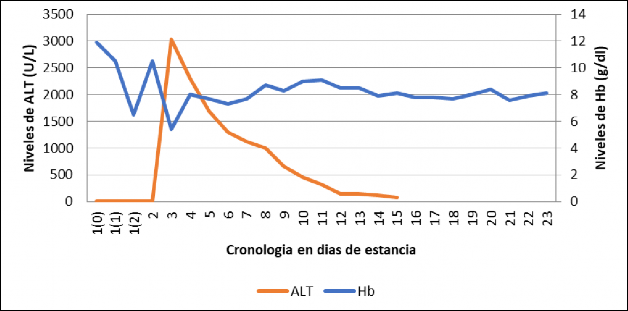
Figure 1. Alanine aminotransferase (ALT) and haemoglobin (Hb) levels during hospital stay.
HH is a condition characterised by low inci- dence but high mortality, especially in patients in intensive care units [8]. Jonsdottir et al. [2] repor- ted an incidence of 1.60% in a high-complexity hospital, where 53% of patients died during their stay and 60% had an estimated maximum survival of one year. The main causes of HH in this population included shock, cardiac arrest, and hypoxia [8-10]. In the case presented, HH originated secondary to postpartum haemo- rrhage in a pregnant woman with no relevant medical history.
Elevated alanine aminotransferase (ALT) levels can be multifactorial. and blood levels above 400 U/L are considered marked hyper- transaminemia (HT), possibly caused by pri- mary acute liver damage, such as viral hepatitis, drug-induced hepatitis, trauma, or intrahepatic cholestasis, or secondary causes such as hy- poxic liver disease, extrahepatic cholestasis, or sepsis [1-4]. During pregnancy, liver function abnormalities may occur with consequent elevation of enzymes due to pre-existing liver
diseases, hyperemesis gravidarum, fatty liver, pregnancy-associated hypertensive disorders, among others. In this regard, it is vital to de- termine the origin and management due to potential maternal and foetal outcomes [6,11].
Although reports of HH associated with pregnancy are scarce, the cases identified agree that haemorrhage and hypovolaemia were underlying causes [11,12]. Kummer et al. [13] documented a case of HH as a late complication of bariatric surgery during the second trimester of pregnancy, consisting of an active jejunal ulcer managed surgically; HH appeared typically in the postoperative period with an ALT elevation of 1710 IU/L, which gra- dually resolved as volemia and hypoxia were corrected. Chou et al. [14] reported HH in a 38- week pregnant woman after a caesarean sec- tion complicated by postpartum haemorrhage. Bimanual massage, surgical management, and administration of haemocomponents were indicated to stabilise the patient. However, despite this, hepatic hypoxia (maximum ALT of 1990 U/L) and hypoxia in other organs such as the kidneys and myocardium were triggered.
Borré Naranjo D., La Valle López O., Escobar Velásquez K., Barajas Lizarazo M. Hypoxic-Ischemic Hepatitis Associated with Obstetric Hemorrhage: A Case Report.
Arch Med (Manizales). 2026;26(1)
In relation to the onset of the clinical picture announced by the elevation of transaminases in the three patients, it was identified in the post-surgical control examinations the day after the haemorrhage, which coincided with the decrease in haemoglobin.
There are three conditions that allow for a clinical diagnosis without requiring a biopsy. In the case presented in this article, all of these criteria can be identified: First, the pregnant woman presented with profuse bleeding as a complication following a caesarean section, as evidenced by the ultrasound scan taken after the procedure indicated by the deterioration in haemodynamic stability. Hypovolaemia was evident from clinical and laboratory findings, as shown in Figure 1. The second criterion is met with the sudden elevation of liver enzymes after hypovolemic shock on the second day of ICU stay; after hysterectomy and salpingo- oophorectomy, alanine aminotransferase in- creased dramatically to 3030 IU/L (reference value 4-36 U/L). Finally, in this case, infectious or toxic causes of hepatic cell necrosis were ru- led out by verifying through previous tests that there were no infections, hepatitis B antigen was negative, VDRL was non-reactive, CRP was less than six, blood and urine cultures
were negative, and there were no infectious symptoms.
Consequently, it is essential to emphasise that HH has a low incidence in the general po- pulation [1,2,15,16]. Therefore, it is crucial to consider its diagnosis in pregnant women who present with sudden liver function impairment without an apparent infectious, obstructive, or toxic cause [16]. This is especially important, as HH can be confused with other obstetric con- ditions, such as HELLP syndrome. A thorough physical examination, a detailed medical history, supported by laboratory tests and accurate cli- nical correlation, are crucial for establishing an accurate diagnosis and guiding the appropriate treatment [11,12].
Diana Borré Naranjo: I declare that I have no impediments or conflicts of interest. Oscar La Valle López: I declare that I have no impe- diments or conflicts of interest. Katty Escobar Velásquez: I declare that I have no impediments or conflicts of interest. Mayra Barajas Lizarazo: I declare that I have no impediments or conflicts of interest.
Funding: None.
Borré Naranjo D., La Valle López O., Escobar Velásquez K., Barajas Lizarazo M. Hypoxic-Ischemic Hepatitis Associated with Obstetric Hemorrhage: A Case Report.
Arch Med (Manizales). 2026;26(1)
Riquelme F. Hepatitis hipóxica. Gastroenterol latinoam. 2013;24:112-5.
Jonsdottir S, Arnardottir MB, Andresson JA, Bjornsson HK, Lund SH, Bjornsson ES. Prevalence, clinical charac- teristics and outcomes of hypoxic hepatitis in critically ill patients. Rev Scand Gastroenterol. 2022;57:311-8. https://doi.org/10.1080/00365521.2021.2005136
Henrion J. Hypoxic hepatitis. Liver Int. 2012;32:1039-52. https://doi.org/10.1111/j.1478-3231.2011.02655.x
Castillo E, Colomina J, Gimeno F, Moll MJ, Guerrero A. Incidencia de la hipertransaminemia marcada en un de- partamento de salud de la Comunidad Valenciana (período 2002-2003). Rev Esp Salud Publica. 2007;81:271-8. Disponible en: https://scielo.isciii.es/scielo.php?script=sci_arttext&pid=S1135-57272007000300004
Waseem N, Chen PH. Hypoxic hepatitis: A review and clinical update. J Clin Transl Hepatol. 2016;4:263-8. https://doi.org/10.14218/JCTH.2016.00022
Vanterpool HM, Avalos GR, Corrales AS, Del Valle LP, Hernández HR. Comportamiento de las hepatopatías en el embarazo valoradas por gastroenterología. Rev Med Electron. 2020;42:1815-25.
Disponible en: http://scielo.sld.cu/scielo.php?script=sci_arttext&pid=S1684-18242020000301815
Fuchs S, Bogomolski V, Paltiel O, Ackerman Z. Ischemic hepatitis: Clinical and laboratory observations of 34 patients. J Clin Gastroenterol. 1998;26:183-6. https://doi.org/10.1097/00004836-199804000-00007
Trilok G, Qing YC, Li-Jun X. Hypoxic hepatitis: A challenging diagnosis. Hepatol Int. 2012;6:663-9. https://doi.org/10.1007/s12072-011-9336-1
Fuhrmann V, Jäger B, Zubkova A, Drolz A. Hypoxic hepatitis - epidemiology, pathophysiology and clinical mana- gement. Wien Klin Wochenschr. 2010;122:129-39. https://doi.org/10.1007/s00508-010-1357-6
Henrion J, Schapira M, Luwaert R, Colin L, Delannoy A, Heller FR. Hypoxic hepatitis: clinical and hemodynamic study in 142 consecutive cases. Medicine (Baltimore). 2003;82:392-406. https://doi.org/10.1097/01.md.0000101573.54295.bd
Nelson DB, Byrne JJ, Cunningham FG. Acute fatty liver of pregnancy. Clin Obstet Gynecol. 2020;63:152-64. https://doi.org/10.1097/GRF.0000000000000494
Liu G, Shang X, Yuan B, Han C, Wang Y. Acute fatty liver of pregnancy: analysis on the diagnosis and treatment of 15 cases. J Reprod Med. 2016;61:282-6. PMID: 27424373
Kummer N, Cackovic M, Paidas M, Funai E. Hypoxic hepatitis in a pregnant patient: A complication of gastric bypass surgery. Am J Perinatol. 2008;25:469-71. https://doi.org/10.1055/s-0028-1085065
Chou MH, Chen YC, Hwang KS, Yu MH, Su HY. Myocardial infarction and ischemic hepatitis complicated by postpartum hemorrhage. Taiwan J Obstet Gynecol. 2016;55:437-40. https://doi.org/10.1016/j.tjog.2016.04.023
Zhao XD, Ye J, Sun YK, Liang JF, Hu L, Chang AC, et al. Hypoxic hepatitis in children after cardiac surgery. Hepatobiliary Pancreat Dis Int. 2023;22:205-9. https://doi.org/10.1016/j.hbpd.2022.09.012
Raurich J, Llompart J, Ferreruela M, Colomar A, Molina M, Royo C, et al. Hypoxic hepatitis in critically ill patients: Incidence, etiology and risk factors for mortality. J Anesth. 2011;25:50-6. https://doi.org/10.1007/s00540-010-1058-3