Violence against men in the city of São Paulo: study of reported cases
Cintia Leci Rodrigues 1, Victoria Hernandez Girnys 2, Juliana Carvalho Tavares Alves 3
1. Teacher at Medical School of the Universidade de Santo Amaro, Master in Public Health, Rua Prof. Enéas de Siqueira Neto, 340, Jardim das Imbuias, São Paulo – SP Brasil 04829-300. E-mail: kikarodrigues@hotmail.com.
2. Medicine student of the Universidade de Santo Amaro. E-mail: victoriagirnys@gmail.com.
3. Medicine student of the Universidade de Santo Amaro. E-mail: julianacarvalhota@hotmail.com.
Archivos de Medicina (Manizales), Volumen 18 N° 1, Enero-Junio 2018, ISSN versión impresa 1657-320X, ISSN versión en línea 2339-3874. Rodrigues C.L.; Hernandez-Girnys V.; Carvalho-Tavares-Alves J.
Recibido para publicación: 27-02-2018 - Versión corregida: 28-04-2018 - Aprobado para publicación: 01-05-2018
Rodrigues CL, Hernandez-Girnys V, Carvalho-Tavares-Alves J. Violence against men in the city of São Paulo: study of reported cases. Arch Med (Manizales) 2018; 18(1):121-6. DOI: https://doi.org/10.30554/archmed.18.1.2564.2018.
Summary
Objective: the objective of this study was to elucidate a growing and poorly studied type of violence. The prevalence of violence against men has been the object of study of international investigations in several countries such as USA, Canada and UK. In recent decades, the focus of research and public attention on violence in Brazil has focused on violence against women; Men, however, also experience significant levels of aggression Materials and methods: this paper describes and analyzed 57,893 cases of violence against man (physical, sexual, psychological, and negligence) reported by SIVVA (Information and Surveillance System of Violence and Accidents) in the city of São Paulo from 2008 to 2015. Results: prevalence was observed throughout the 8 years evaluated in the study of domestic physical violence or by acquaintances with use of corporal force, predominating in the groups of young and adults, Caucasian, without prior use of drugs or alcohol, and half of the cases in the mentally handicapped. Conclusion: continuing to ignore this situation will make it unfeasible for health development, the creation of support and intervention services for this growing population.
Key words: health policy, violence, halth information systems.
Violencia contra el hombre en la ciudad de São Paulo: estudio de los casos notificados
Resumen
Objetivo: elucidar un tipo de violencia creciente y poco estudiada. La prevalencia de la violencia contra el hombre ha sido objeto de estudio de investigaciones internacionales en diversos países como USA, Canadá y el Reino Unido. En las últimas décadas, el foco de la investigación y de la atención pública en la violencia en Brasil se centró en la violencia contra las mujeres; Los hombres pero también experimentan niveles significativos de agresión. Materiales y métodos: este trabajo describió y analizó 57.893 casos de notificación de violencia contra el hombre (fisica, sexual, psicologica y negligencia) notificados por el SIVVA (Sistema de Información y Vigilancia de Violencia y Accidentes) en la ciudad de São Paulo, Brasil del año 2008 a 2015. Resultados: se observó prevalencia a lo largo de los 8 años evaluados en el estudio de la violencia física doméstica o por conocidos con uso de fuerza corporal, predominando en los grupos de jóvenes y adultos, de etnia caucásica, sin uso previo de drogas o alcohol, siendo la mitad de los casos en discapacitados mentales. Conclusiones: continuar ignorando esta situación inviabilizará el desarrollo de la salud, la creación de servicios de apoyo y de intervención ante esta población creciente.
Palabras clave: política de salud, violencia, sistemas de Información en salud.
Introduction
Violence is one of the most relevant public health issues in the world. The World Health Organization defines violence as the intentional use of physical force or power, whether real or threatened, against itself, against another person or against a group or community, resulting in or likely to result in injury, death, psychological damage, developmental disability and deprivation [1]. In most cases, the woman is the main victim, but it is known today that many men suffer from violence, be it financial, physical, sexual or emotional. The fact that there is violence against men or women is an alarm for a nation and should be carefully evaluated in order to bring about improvements in the quality of life of the population. The prevalence of violence against men has been the object of study of international investigations. In the USA, it is estimated that between 25% and 50% of all domestic violence victims are men [2]. In the United Kingdom, men are estimated to constitute approximately 43 per cent of this type of aggression [3]. In Canada, an estimated 47 per cent of victims of violence are men [4]. In the same sense, a meta-analysis found that in over 80 studies of physical violence among heterosexual partners, 35% of the victims injured by the partner, and 39% of those who needed medical treatment were men [5]. A Brazilian study indicates that within marital violence men are not the main victims, although women are equally aggressors in the different types of violence between the couple [6]. Survey on the violence between boyfriends conducted with young people from 15 to 19 years revealed that 49% of the boys and 32.8% of the girls had practiced some type of sexual aggression and 28.5% of women and 16.8% of men admitted to having physically assaulted[7]. In addition, 33.3% of the girls and 22.6% of the boys acknowledged that they had committed different types of aggression [7]. In the face of this global scenario in 2000, the United States created the DAHM - The Domestic Abuse Helpline for Men, the first aid center to men who are victims of intimate partner violence, whose objective is to offer health services through doctors and psychologists, shelter for victims, and legal support [8]. In Brazil there are no specialized aid centers for the victim of violence, and the number of cases is still underreported. In addition, there is little investment in prevention measures to address this problem. Faced with this problematic, this work seeks to elucidate a reality of violence in Brazil little spoken, which negatively impacts the public health of the country. The objective of the present research is to describe and analyze the cases of notification of violence against man notified by SIVVA (System of Information and Surveillance of Violence and Accidents) in the city of São Paulo from the year 2008 to 2015.
Materials and methods
A cross - sectional study was carried out, with a quantitative, descriptive and retrospective approach. The study covered a total of 57,893 men victims of violence (physical, sexual, psychological and neglect) from 2008 to 2015 in the city of Sao Paulo from 0 to 90 years or more. All variables were based on data from the public domain informed by SIVVA (System of Information and Surveillance of Violence and Accidents) of the Municipal Health Department of the city of São Paulo. The variables used for the study were: gender, type of violence (sexual and psychological physics and neglect), age of victim and aggressor, sex of the aggressor, frequency of violence, attachment of the aggressor to the victim, instrument of aggression use of body force, firearm, white weapon, blunt object, hanging / suffocation), frequency of aggression, place of occurrence (residence, public road, shelter, asylum, bar and related, daycare, school, workplace and other ), type of victim’s disability (physical, mental, visual), use of alcohol and drugs, ethnicity of the victim [9]. The research project exempted approval of the Research Ethics of the University, because it is the use of secondary data of public domain database, as recommended in the Resolution of the National Health Council (CNS) 466/12.
Bias control: It was previously studied and stablished the variables for the study, reducing this way the bias of bad classification. Also, from the moment of the design os the study, possible confounding variables were foreseen and an adequate control of these was done by restriction of data. No type of statisical study was performed in this study; since it is a descriptive study.
Results
Table 1. Relationship with the agressor. Data by SIVVA
(Sistema de Información y Vigilancia de Violencia y Accidentes)

Table 2. Gender of the agressor. Data by SIVVA
(Sistema de Información y Vigilancia de Violencia y Accidentes)

Table 3. Instruments of agression. Data by SIVVA
(Sistema de Información y Vigilancia de Violencia y Accidentes)

The study evaluated a total of 57,893 cases of men who were victims of violence in the city of Sao Paulo from 2008 to 2015. There were 4386 cases in 2015, 10773 in 2014, 9922 in 2013, 8922 in 2012, 7334 in 2011, 6762 in 2010, 6927 in 2009 and 2867 in 2008. Physical aggression was the main component in all the studied years with 87.3% of cases in 2015, 85% of cases in 2014, 81.2% of cases in cases in 2012, 81.6% of the cases in 2011, 80.6% of the cases in 2010, 86.3% of the cases in 2009 and 87.3% of the cases in 2008 (Figure 1). The second most occurred was psychological aggression in all the study years ranging from 6.6% of cases in 2015 to 10.9% of cases in 2011. Regarding the age of study participants, the majority of cases found were in youngsters and adults aged 15-39 years in all years, being most of 25-29 years. In this age there were 15.8% of cases in 2015, 16.5% of cases in 2014, 14% of cases in 2013, 13.9% of cases in 2012, 15% of cases in 2011, 15.1% of cases in cases in 2010, 16.1% of cases in 2009 and 14.7% of cases in 2008. In all years there was at least one report of violence against older men over 65 and in children under 4 years of age. The sex of the predominant aggressor was male (Table 2). Aggressive women accounted in the study for about 40% of cases from 2008 to 2015. The age of the aggressor was predominantly among young people aged 25-29 years, averaging 15% of cases per year. The relationship between the victim and the aggressor was predominantly familial (Table 1): 37.8% of cases in 2015, 40.6% of cases in 2014, 41.1% of cases in 2013, 43.2% of cases in 2012, 42.2% of cases in 2011, 43.5% of cases in 2010, 34.7% of cases in 2009 and 35.2% of cases in 2008. The second and third predominant relationships were known and unknown with an average of around 20% of the cases per year. The instrument of aggression was mostly body strength with 75% of cases per year (Table 3). The frequency of the attacks was mostly only one time with 70% of the cases, followed by 2 to 5 times representing 15% of the cases. The majority of the victims who had some type of deficiency were of the mental type representing 50% of the cases, followed by physical deficiency with 20% of the cases. About 80% of the victims were not using alcohol or drugs on the day of the aggression. When analyzed the ethnicity of the victim it is noticed that 50% were Caucasian and 40% brown, followed by 10% of blacks. Regarding the place of the occurrence, 60% of the cases occurred within the victim’s residence in all the years of the study and about 30% in the public way.
Discussion
It is known that in the current national and world scenario, women are still the main victims of violence. However, 40% of female aggressors were found in the present study, showing that there is also violence against men in an important way. The underreporting of these data should be underscored, since men are less likely than women to seek help, as evidenced by research into health and the use of health services by men [10]. In addition, they do not seek help because of social obstacles (shame, fear, denial, stigmatization) and lack of support, including aid services [2,10].
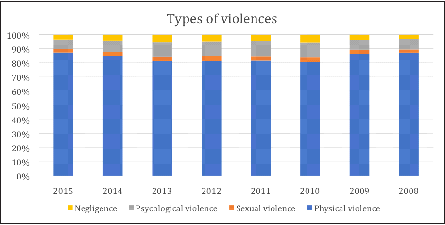
Figure 1. Types of violence.
Data by SIVVA (Sistema de
Información y Vigilancia de
Violencia y Accidentes).
The number of notifications of violence against men increased significantly from 2008 to 2014. Men tend to minimize their abuse and try to avoid social stigma about their inability to protect themselves [2,10]. For this reason, they tend not to seek help and health services when they suffer some form of abuse. However, today’s society has been changing and the social role of women has changed. The man who was once the “unacceptable” victim of violence becomes a possible victim of violence. The most reported violence was physical violence, and the object of violence was largely corporal force. It is suggested that this data should highlight the prevalence of violence against some male groups: husbands who are victims of marital violence, the elderly, and children [11, 12]. While sexual violence against men is generally more prevalent in heterosexual groups, but it is not exclusive [13]. The groups of both aggressors and victims are in their prevalence of young or adults, showing once again the marital violence that occurs more in this age group [11, 12]. but also among school boyfriends [7]. It is important to emphasize the importance of approaching this issue even among young people in order to avoid the propagation of violent acts in adult life. According to reports in the current literature, both for violence against men and for women, the main aggressor is someone of the family, or known to be close [13,14,15]. Due to this, today there are discussions about the applicability of the “Maria da Penha’s law” in Brazil for men, since these occurrences are more frequent and occur mostly inside the homes [16,17]. Half of all cases of violence against men are for the mentally or physically disabled; This fact is alarming and calls attention to a precariousness of protection services to these victims, [11] who are more fragile and susceptible are not often able to even report what happened. In the present study, half of the victims were Caucasian. No data were found in the literature correlating prevalence of violence in men related to ethnicity.
Violence against men is as important as violence against women as they both evidence a sick society. It is desirable that this violence no longer remain hidden. Therefore, to propose a different view of the cases of violence in the city of Sao Paulo it is necessary a better understanding of this process and the impacts that this violence may cause in the long term in public health. Continuing to ignore this situation will make it unfeasible for health development, the creation of support and intervention services for this heterogeneous and so unfortunately growing population.
It is a study based on public information system, which does not at any time hurt the confidentiality of the information acquired, in addition it is limited because it depends on the notification by the health teams to be registered in the system.
Conflict of interest: none of the authors has conflicts of interest.
Sources of financing: there are none.
Literature cited
- OMS, Organização Mundial de Saúde. Genebra, Relatório Mundial sobre Violência e Saúde: OMS; 2002. Version of the Introduction to the World Report on Violence and Health (WHO). Geneve: WHO, 2002.
- Hines DA, Douglas EM. Understanding the Use of Violence Among Men Who Sustain Intimate Terrorism. Partner Abuse 2011; 2(2):259–283.
- Walby S, Allen J. Domestic violence, sexual assault and stalking: findings from the British Crime Survey. London: The Research, Development and Statistics Directorat; 2004.
- Laroche D. Aspects of the Context and Conse- quences of Domestic Violence—Situational Cou- ple Violence and Intimate Terrorism in Canada in 1999. Quebec: Institute de la Statistique du Quebec; 2005.
- Archer J. Sex differences in aggression be- tween heterosexual partners: a meta-analyt- ic review. Psychol Bull 2000; 126(5):651-80. DOI:10.1037//0033-2909.126.5.651.
- Carvalho L, Senra LX. Homem vítima de violência conjugal: uma análise bibliométrica e sistemáti- ca. Revista cientifica da Faminas 2014; 10(2):120- 138.
- Reichenheim ME, de Souza ER, Moraes CL, de Mello-Jorge MH, da Silva CM, de Souza-Minayo MC.. Violence and injuries in Brazil: the effect, progress made, and challenges ahead. The Lancet 2011 DOI: 10.1016/S0140-6736-1160053-6.
- Hines, DA, Brown, J, Dunning, E. Characteristics of callers to the Domestic Abuse Helpline for Men. J Fam Viol 2007; 22:63. DOI: HTTPS://DOI. ORG/10.1007/S10896-006-9052-0 .
- SIVVA - Sistema de Informação e Vigilância de Violências e Acidentes - SIVVA. Prefeitura de São Paulo; 2013 [acesso em 28 out. 2017]. Disponível em: http:// www.prefeitura.sp.gov.br.
- Tsui V, Cheung M, Leung P. Help-seeking among male victims of partner abuse: men’s hard times. Journal of community Psychol 2010; 38(6):769-780.. DOI: https://doi.org/10.1002/jcop.20394.
- Machado A, Matos M. Homens de quem não se fala: as vítimas esquecidas da violência na inti- midade. Lisboa: Sociedade Portuguesa de Psiquiatria e Psicologia da Justiça. Revista Psiquia- tria, Psicologia & Justiça; 2012.
- Ferreira-cezario AC, ed Carvalho LL, Moura-Lou- renço L. Violência Contra o Homem Perpetrada por Sua Parceira: Perspectivas de Psicólogos e Assistentes Sociais. . Psicologia em Pes- quisa 2016; 10(1):76.84. DOI: 10.5327/Z1982-1247201600010010.
- Schimitz D. O homem como vitima do delito de violaçaà sexual. UNIPLAC 2017; 5(1):0-0.
- Dotoli F, Castro L. Violência doméstica contra o homem: de agressor a agredido. Revista Ibero-Americana de Estudos em Educação 2016; 10:1641-1659.
- Morais-Brilhante AV, Remigio-Moreira GA, de Sou- za-Vierira LJE, Fontenelle-Catrib AM. A bibliomet- ric study on gender violence. Saúde Soc 2016; 25(3):703-715. DOI: https://dx.doi.org/10.1590/ s0104-12902016148937
- Rodrigues-Araujo C, de Oliveira KA, de Carvalho TC, de Souza VA, Barbará Cl. Contemporaneidade da Lei Maria da Penha; Revista do Curso de Direito da Universidade Braz Cubas 2017; 1(1):0-0.
- Oliveira I. Homem é homem: narrativas sobre gênero e violência em um grupo reflexivo com homens denunciados por crimes da Lei Maria da Penha. Dissertação de Mestrado. São Paulo: Faculdade de Filosofia, Letras e Ciências Humanas, Universidade de São Paulo; 2016.